
SAP S/4HANA implementation is often misunderstood as a technical upgrade. In reality, it is one of the most strategically significant business transformation projects an organization can undertake.
At its core, SAP S/4HANA replaces traditional ERP systems with a real-time, in-memory platform that changes how companies operate, analyze data, and make decisions.
Strategic POV: Companies that treat SAP S/4HANA implementation as a “system migration” tend to fail. Those that treat it as a business transformation initiative unlock its full value.
Table of Contents
What Is SAP S/4HANA Implementation?
SAP S/4HANA implementation refers to the process of deploying SAP’s next-generation ERP system—including planning, data migration, system configuration, and business process transformation.
Unlike legacy ERP upgrades, S/4HANA implementation often involves reimagining how a business operates, not just moving data from one system to another.
Core Components of SAP S/4HANA Implementation
| Component | Description | Why It Matters |
| System Architecture | Designing system landscape | Impacts scalability and performance |
| Data Migration | Moving legacy data into S/4HANA | Poor data = poor outcomes |
| Business Process Redesign | Aligning workflows with S/4HANA | Enables efficiency gains |
| Integration | Connecting with external tools | Ensures seamless operations |
| Testing | Validating system functionality | Reduces go-live risk |
| Change Management | Training and adoption | Critical for success |
Why Businesses Are Moving to SAP S/4HANA
Organizations are not upgrading by choice alone—there are compelling business and technical drivers.
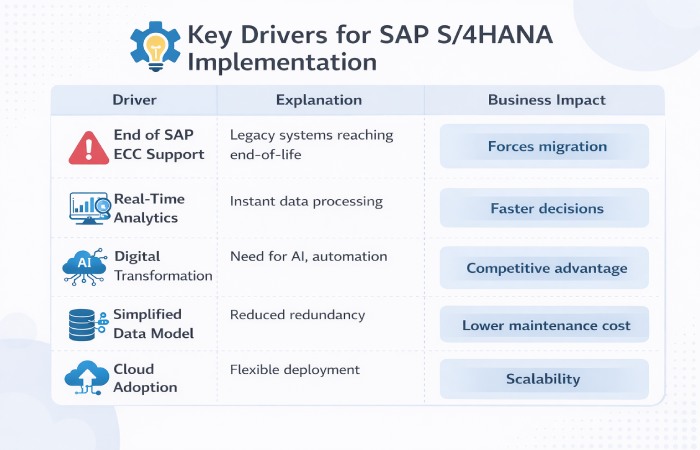
According to SAP, S/4HANA is designed to help businesses run live and operate in real time, eliminating delays caused by batch processing.
SAP S/4HANA Implementation Approaches – Greenfield vs Brownfield vs Hybrid
Choosing the right approach is one of the most critical decisions—and often the most misunderstood.
| Approach | Definition | Best For | Pros | Cons |
| Greenfield | New implementation from scratch | Companies seeking transformation | Clean system, optimized processes | High cost, longer timeline |
| Brownfield | Conversion of existing SAP system | Companies wanting minimal disruption | Faster, lower risk | Carries legacy inefficiencies |
| Hybrid (Landscape Transformation) | Selective migration + redesign | Large enterprises | Flexible, scalable | Complex execution |
When to Choose Each Approach
| Scenario | Recommended Approach |
| Legacy system is outdated | Greenfield |
| Stable processes, minimal change needed | Brownfield |
| Multiple systems across regions | Hybrid |
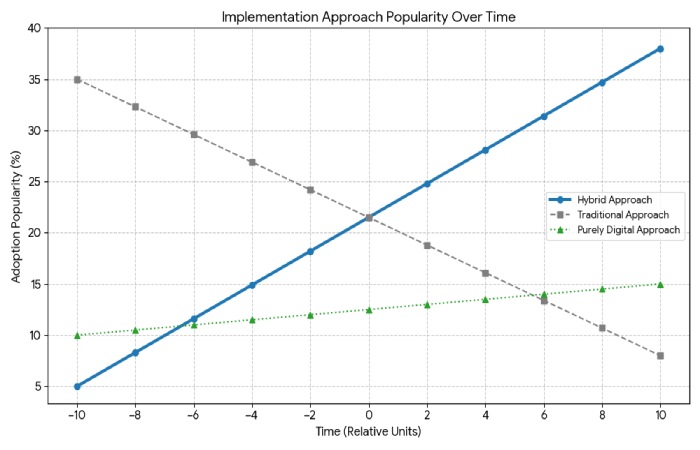
Implementation Approach Popularity
Hybrid implementations are growing because enterprises want transformation without full disruption.
Deployment Options: Cloud vs On-Premise vs Hybrid
Deployment choice significantly impacts cost, flexibility, and scalability. According to Gartner, cloud ERP adoption continues to rise due to cost efficiency and scalability benefits.
| Deployment Type | Description | Advantages | Disadvantages |
| Cloud | Hosted by SAP or third-party | Scalable, lower upfront cost | Less control |
| On-Premise | Hosted internally | Full control, customization | High infrastructure cost |
| Hybrid | Combination of both | Flexibility | Complex management |
SAP S/4HANA Implementation Process – Step-by-Step
Understanding the lifecycle helps set realistic expectations.
| Phase | Key Activities | Output |
| Discover | Business case, ROI | Project roadmap |
| Prepare | System readiness | Implementation plan |
| Explore | Process design | Blueprint |
| Realize | Configuration & testing | Working system |
| Deploy | Go-live | Operational ERP |
| Run | Optimization | Continuous improvement |
Timeline Breakdown
| Company Size | Duration | Complexity Level |
| Small | 6–12 months | Low |
| Medium | 12–18 months | Medium |
| Enterprise | 18–36+ months | High |
Cost Breakdown of SAP S/4HANA Implementation
Cost Components
| Cost Area | Details |
| Licensing | SAP software cost |
| Infrastructure | Cloud/on-premise setup |
| Consulting | Implementation partners |
| Internal Resources | Staff involvement |
| Training | User onboarding |
Estimated Cost Range
| Organization Size | Estimated Cost |
| Small | $250K – $1M |
| Mid-size | $500K – $5M |
| Enterprise | $10M – $100M+ |
Research from Deloitte highlights that poor planning and scope creep are the top reasons for cost overruns.
Key Challenges in SAP S/4HANA Implementation
| Challenge | Root Cause | Impact |
| Data Migration Issues | Poor data quality | Delays, errors |
| Change Resistance | Lack of training | Low adoption |
| Over-Customization | Legacy mindset | Reduced efficiency |
| Skill Shortage | Limited expertise | Increased cost |
Benefits of SAP S/4HANA Implementation
| Benefit | Description | Outcome |
| Real-Time Analytics | Instant reporting | Faster decisions |
| Simplified Processes | Reduced complexity | Efficiency |
| Automation | AI-driven workflows | Cost savings |
| Better UX | Fiori interface | Improved productivity |
ROI Growth After Implementation
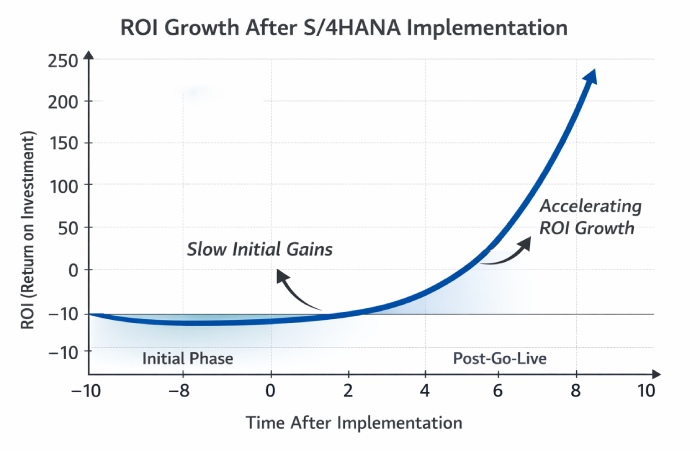
ROI typically accelerates after stabilization (post go-live phase).
SAP S/4HANA vs Traditional ERP
| Feature | Traditional ERP | SAP S/4HANA |
| Data Processing | Batch | Real-time |
| Database | Disk-based | In-memory |
| Reporting | Delayed | Instant |
| Flexibility | Limited | High |
Best Practices for Successful Implementation
| Factor | Why It Matters |
| Executive Sponsorship | Ensures alignment |
| Clear Business Goals | Prevents scope creep |
| Data Cleansing | Improves accuracy |
| User Training | Drives adoption |
When NOT to Implement SAP S/4HANA
| Scenario | Risk |
| Poor data quality | Failed migration |
| No clear strategy | Budget overruns |
| Weak leadership support | Project failure |
Expert Insight: What Most Companies Get Wrong
Most organizations focus heavily on technology selection and underestimate:
- Organizational change
- Process redesign
- Data governance
S/4HANA does not fix broken processes—it exposes them faster.
Final Thoughts
SAP S/4HANA implementation is ultimately a high-stakes business transformation, not a routine system upgrade. While the technology delivers real-time insights, automation, and scalability, the true success of any implementation depends on how well an organization aligns its processes, people, and data with these capabilities.
Companies that approach it strategically—by simplifying workflows, ensuring data quality, and driving strong change management—are far more likely to achieve meaningful ROI. In contrast, those who treat it as a purely technical migration often struggle with delays, cost overruns, and underwhelming results. In the end, SAP S/4HANA doesn’t just modernize systems—it reshapes how businesses operate and compete in a data-driven world.
FAQs
What is SAP S/4HANA implementation in simple terms?
It is the process of deploying SAP’s modern ERP system to enable real-time business operations.
What are the types of SAP S/4HANA implementation?
Greenfield, Brownfield, and Hybrid approaches.
Which deployment is best?
Cloud for flexibility, on-premise for control, hybrid for balance.
How long does implementation take?
Typically, 6 months to 3 years, depending on size and complexity.