
Re:Zero is not a power fantasy—it is a trauma-loop survival narrative that deconstructs the isekai hero through psychological collapse and reconstruction. Many Re:Zero guides list characters and plot beats but fail to explain why the series resonates so deeply or how its structure fundamentally differs from typical isekai anime. In answer to the biggest questions fans and newcomers have:
Re:Zero is a character-driven dark fantasy anime with a complex reset mechanic (Return by Death) that fuels emotional and psychological stakes rather than combat progression. It’s best understood through its narrative architecture and thematic design, not just episodic plot summaries.
Table of Contents
What Is Re:Zero?
“Re:Zero − Starting Life in Another World” (Japanese: Re: ゼロから始める異世界生活) is an anime based on the light novel series by Tappei Nagatsuki and illustrated by Shin’ichirō Ōtsuka. It premiered in April 2016 with three seasons 66 episodes + 2 Original Video Animation (OVAs), and a fourth season slated for 2026 release.
The story follows Subaru Natsuki, an ordinary young man transported to a fantasy world. Rather than gaining combat prowess, Subaru acquires a singular ability: Return By Death — upon dying, time resets to a prior checkpoint, and only Subaru retains memory. This mechanic becomes the engine of psychological conflict.
Re:Zero Series Overview
| Category | Details |
|---|---|
| Title | Re:Zero − Starting Life in Another World |
| Also Known As | Re: Zero |
| Release Date (US) | April 3, 2016 |
| Country of Origin | Japan |
| Original Language | Japanese |
| Available Languages | Japanese, English, Spanish, Portuguese, French, German |
| Official Site (Japan) | Official website (Japanese) |
| Official Social Media | Official Twitter (Japan) |
| Production Companies | Kadokawa, Media Factory, White Fox |
| Animation Studio | White Fox |
| Music Composer | Kenichiro Suehiro |
Direction by Season
| Season | Director |
|---|---|
| Season 1 | Masaharu Watanabe |
| Season 2 | Masaharu Watanabe |
| Season 3 | Masahiro Shinohara |
| Season 4 (Announced) | Masahiro Shinohara |
Season Release Dates
| Season | Episode Count | Original Japanese Release Dates | Notes |
|---|---|---|---|
| Season 1 | 25 Episodes | April 4, 2016 – September 19, 2016 | Initial broadcast |
| Season 2 (Part 1) | 13 Episodes | July 8, 2020 – September 30, 2020 | Delayed due to COVID-19 |
| Season 2 (Part 2) | 12 Episodes | January 6, 2021 – March 24, 2021 | Sanctuary arc conclusion |
| Season 3 (Part 1 – Assault Arc) | 8 Episodes | October 2, 2024 – November 20, 2024 | Political escalation |
| Season 3 (Part 2 – Counterattack Arc) | 8 Episodes | February 5, 2025 – March 26, 2025 | Continuation of major conflicts |
| Season 4 | TBA | Announced for 2026 | Based on later light novel arcs |
Cast of Re:Zero
| Character | Japanese Voice Actor | English Dub |
|---|---|---|
| Subaru Natsuki | Yūsuke Kobayashi | (Various depending on platform) |
| Emilia | Rie Takahashi | – |
| Rem | Inori Minase | – |
| Ram | Rie Murakawa | – |
| Beatrice | Yumi Uchiyama | – |
Where to Watch & Pricing
| Streaming Platform | Region | Pricing (Approx) | Notes |
|---|---|---|---|
| Crunchyroll | Global | ₹39–₹149/month (India) | All seasons & OVAs available |
| Netflix | Japan (others vary) | Included with subscription | Director’s Cut also available |
| Amazon Channel | Select | Subscription pricing | Some seasons available |
| Muse Asia YouTube | Asia | Free | Season 3 simulcast |
Streaming price varies by region and platform. Crunchyroll often provides dubbed/subbed versions, while Netflix availability is region-dependent.
Seasons & Storylines
| Season | Episodes | Story Focus | Key Arcs | Release |
|---|---|---|---|---|
| S 1 | 25 | Introduction + identity collapse | Manor, White Whale, Witch cult arc | 2016 |
| S 2 | 25 | Deep internal struggles | Sanctuary & Witch Tea Party | 2020–21 |
| S 3 | 16 | Large-scale conflict | Assault Arc + Counterattack Arc | 2024–25 |
| S 4 | TBA | Future arcs | Pleiades Watchtower, more | 2026 |
| OVAs | 2 | Side stories | Memory Snow, Frozen Bonds | 2018–19 |
Season Breakdown: What Happens
- Season 1 – Introduction & Identity Collapse
Subaru is transported into a fantasy world.
Learns “Return by Death” after brutal defeats.
Begins rebuilding relationships (Rem, Emilia).
Confronts the White Whale and Witch Cult forces.
Season 1 lays the emotional groundwork—Subaru’s mindset shifts from carefree to desperate survival.
- Season 2 – Inner Demons & Witch Arc
Focus shifts inward, examining trauma.
Sanctuary arc reveals psychological layers of the cast.
Subaru faces powerful metaphysical forces.
Witch Tea Party deepens lore on the Witches.
Season 2 is often cited as the franchise’s most psychologically heavy arc.
- Season 3 – Assault & Counterattack
Split into two halves: Assault and Counterattack.
Features large battles and shifting alliances.
Increased stakes across regions and political fronts.
- Season 4 – What’s Next (2026)
New arcs from the light novel (like Pleiades Watchtower).
New cast members confirmed, e.g., Shaula voiced by Fairouz Ai.
Watch Seasons on Crunchyroll (sub/dub availability)
See Netflix for Region-Specific Availability
Ratings & Reviews
| Source | Overall Score |
|---|---|
| MyAnimeList (Simkl) | 8.3–8.5 /10 |
| IMDB (JustWatch) | ~8.1 /10 |
| Rotten Tomatoes (Season 1 & 3) | Limited reviews, positive audience notes |
| Anime Awards | Won Best Isekai (2025) |
Here’s a graphic view of average user ratings across seasons:
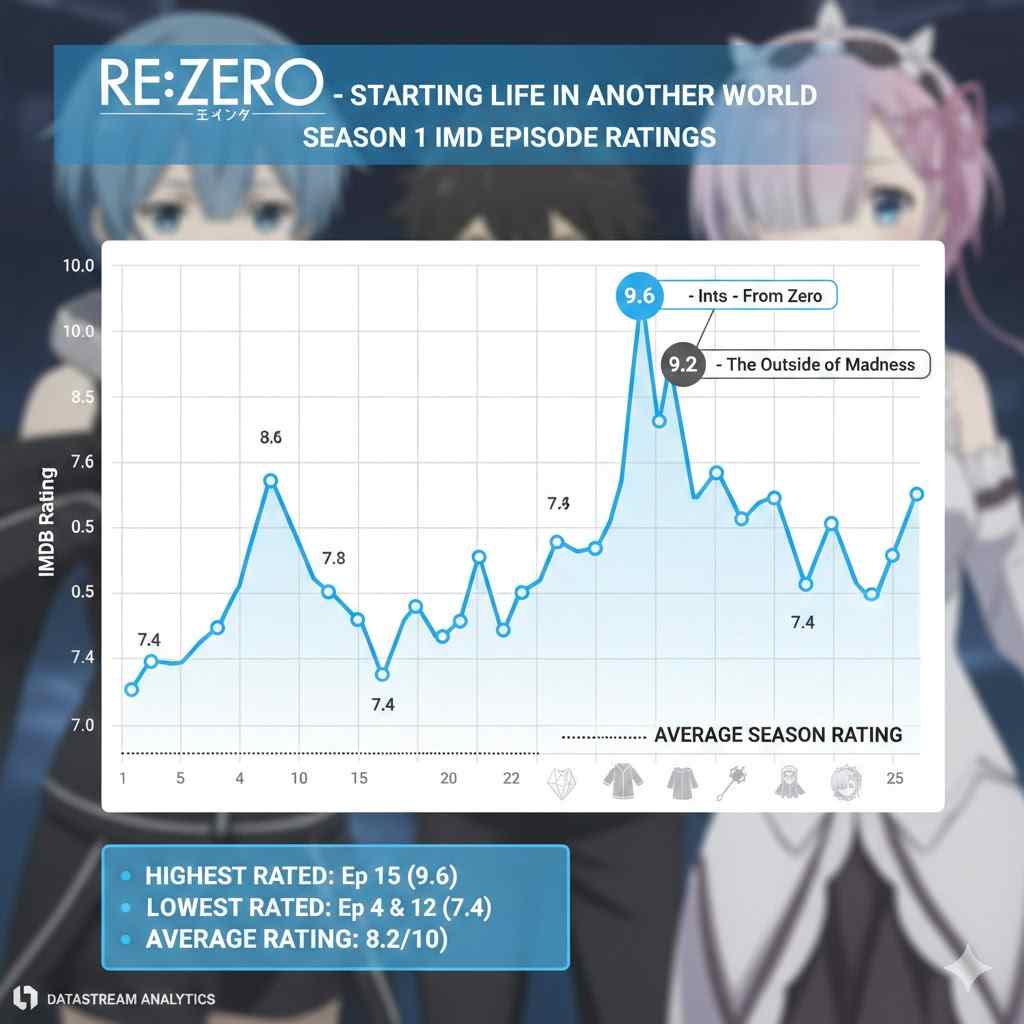
Key Observations
-
Ratings broadly stay high across seasons.
-
Season 2’s depth contributed to strong fan acclaim.
-
Season 3’s action drew renewed interest and awards.
Critical Reception
Critics often highlight:
-
Emotional complexity
-
Subversion of isekai tropes
-
Narrative risk-taking
Rotten Tomatoes lists positive audience reviews for both Season 1 and 3, noting how the series pushes beyond typical genre expectations.
Series Strengths & Weaknesses
| Aspect | Strength | Notes |
|---|---|---|
| Emotional Depth | 5 Stars | Sensitive exploration of trauma |
| Worldbuilding | 4 Stars | Complex but rewarding |
| Pacing | 3 Stars | Some arcs feel slow |
| Accessibility | 2 Stars | Early episodes are heavy |
| Combat / Action | 4 Stars | Rises strongly in later seasons |
Insight: Re: Zero is not light entertainment. It demands emotional investment.
Compare With Other Series
| Title | Tone | Protagonist Arc | Reset Mechanic? | Viewer Experience |
|---|---|---|---|---|
| Re:Zero | Dark, psychological | Growth via trauma | Yes | Intense, deep |
| Sword Art Online | Action, adventure | Skill leveling | No | Balanced, broad appeal |
| That Time I Got Reincarnated as a Slime | Light, fun | Power progression | No | Easygoing |
| Mushoku Tensei | Mature, reflective | Gradual maturingNo | Thoughtful |
Re:Zero stands out for transforming the reset mechanic into emotional conflict rather than gameplay style convenience. It remains distinct from isekai focused on power progression, and leans into survival psychology instead.
What Makes Re:Zero Different
1. Return by Death as Narrative Engine
Instead of empowering Subaru, it exacerbates his psychological burden—each reset deepens trauma.
2. High Emotional Stakes
Emotional pain becomes plot propulsion.
3. Political & Metaphysical Layers
Royal Selection and Witch mythos add stakes outside pure combat.
4. Genre Impact
The series has influenced darker isekai, where psychological realism is more common than ever.
Best Approach to Watching
If episodic pacing feels overwhelming, the Director’s Cut offers hour-long episodes with added polish and smoother transitions.
| Step | Content Order | Why It Matters |
|---|---|---|
| 1 | Season 1 (original or Director’s Cut) | Foundation & tone |
| 2 | Memory Snow | Side but enjoyable |
| 3 | Frozen Bonds | Early character depth |
| 4 | Season 2 | Psychological core |
| 5 | Season 3 | World expansion |
| 6 | Wait for Season 4 | New arcs |
Final Verdict: Is Re:Zero Worth Watching?
Yes — if you want a deep, emotional story that challenges typical fantasy expectations.
Not recommended if you want purely escapist or action-only anime.
Re:Zero’s legacy lies in how it:
-
Deconstructs the isekai hero
-
Makes emotional cost central
-
Rewards patient, analytical viewing
Its sustained high ratings, global fanbase, and award recognition (e.g., Best Isekai at Crunchyroll Anime Awards) show it’s not just popular—but influential.