
The comparison between the NVIDIA GeForce GTX 1080 and the NVIDIA GeForce RTX 3060 (Gtx 1080 Vs. Rtx 3060) is one of the most debated GPU matchups among PC gamers and builders.
At first glance, the comparison looks simple: the RTX 3060 is newer, supports ray tracing, and includes modern AI-based technologies like DLSS. But the GTX 1080 was a flagship GPU of its generation, while the RTX 3060 sits in the mid-range tier of the RTX 30-series. It raises a practical question for gamers and PC builders:
Is the newer RTX 3060 actually faster than the older GTX 1080, or does the flagship from the past still hold its ground?
Table of Contents
What are the GTX 1080 and RTX 3060?
The NVIDIA GeForce GTX 1080 and the NVIDIA GeForce RTX 3060 are graphics cards developed by NVIDIA for gaming, video rendering, and other graphics-intensive tasks. The GTX 1080, released in 2016 and based on the Pascal architecture, was a high-end GPU known for strong traditional gaming performance.
The RTX 3060, launched in 2021 with the Ampere architecture, is a newer mid-range GPU that adds modern technologies like real-time ray tracing and NVIDIA DLSS for improved performance and visual quality in modern games.
Quick Comparison: GTX 1080 vs RTX 3060
The RTX 3060 offers modern features and more memory, but the GTX 1080 was originally built for higher raw performance.
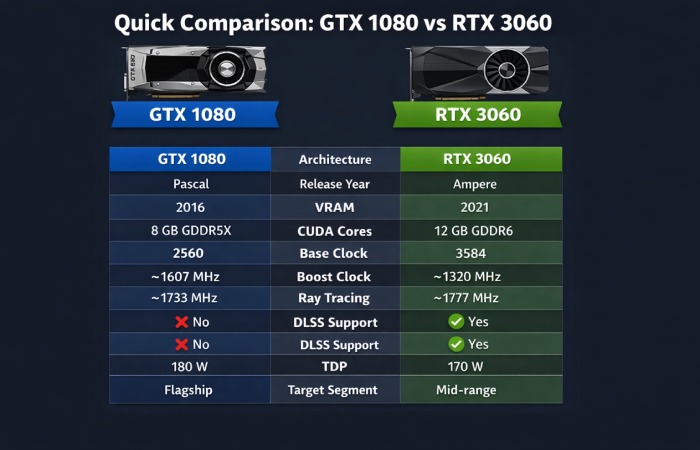
Gtx 1080 Vs. Rtx 3060 Specification
| Specification | NVIDIA GeForce GTX 1080 | NVIDIA GeForce RTX 3060 |
| Architecture | Pascal | Ampere |
| Release Year | 2016 | 2021 |
| CUDA Cores | 2560 | 3584 |
| Base Clock | 1607 MHz | 1320 MHz |
| Boost Clock | 1733 MHz | 1777 MHz |
| VRAM | 8 GB GDDR5X | 12 GB GDDR6 |
| Memory Interface | 256-bit | 192-bit |
| Memory Bandwidth | 320 GB/s | ~360 GB/s |
| Ray Tracing Cores | No | 2nd Gen |
| Tensor Cores | No | 3rd Gen |
| DirectX Support | DirectX 12 | DirectX 12 Ultimate |
| PCIe Interface | PCIe 3.0 | PCIe 4.0 |
| TDP | 180W | 170W |
| Max Resolution | 7680×4320 | 7680×4320 |
The GTX 1080 includes 2560 CUDA cores and 8GB GDDR5X memory, while the RTX 3060 increases this to 3584 CUDA cores and 12GB GDDR6 memory, along with newer AI and ray-tracing hardware.
What are the prices?
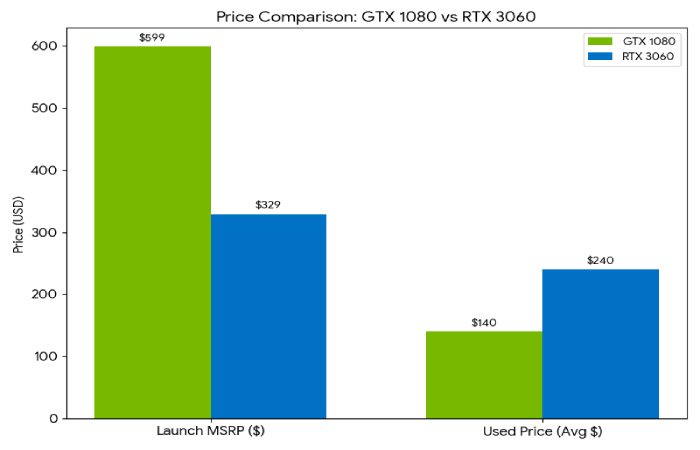
| Price Category | GTX 1080 | RTX 3060 |
| Launch Year | 2016 | 2021 |
| Launch MSRP (Global) | $599 | $329 |
| Founder Edition Launch Price | $699 | ~$329–$349 |
| Typical New Price Today | Mostly discontinued | $250 – $350 |
| Typical Used Price (Global Market) | $100 – $180 | $200 – $280 |
| Budget Segment | Used flagship GPU | Mid-range modern GPU |
Where to Buy?
| Platform | GTX 1080 Availability | RTX 3060 Availability | Typical Price Range | Notes |
| Amazon | Mostly used | New & used | ₹25k–₹45k | Reliable shipping |
| Flipkart | Rare | Available | ₹24k–₹35k | Popular in India |
| PCStudio | Used market | New GPUs | ₹25k–₹40k | Trusted PC hardware store |
| MDComputers | Used/refurbished | New GPUs | ₹26k–₹38k | Popular among gamers |
| OLX / Facebook Marketplace | Common | Sometimes | ₹12k–₹25k | Used deals |
| Newegg / International stores | Rare | Available | $250–$350 | Global availability |
Key Features and Future-Proofing
| Feature | GTX 1080 | RTX 3060 | Impact for Users |
| Ray Tracing | Not supported | Supported | Realistic lighting and reflections |
| DLSS (AI Upscaling) | No | Yes | Higher FPS with AI scaling |
| VRAM Capacity | 8 GB | 12 GB | Better for modern AAA games |
| AI / Tensor Cores | None | Yes | Faster AI workloads |
| Driver Longevity | Ending optimization support | Still fully supported | Better long-term compatibility |
| PCIe Generation | PCIe 3.0 | PCIe 4.0 | Faster bandwidth with new CPUs |
| Streaming & Creator Tools | Basic NVENC | Improved NVENC + Broadcast | Better streaming and video editing |
| Future Gaming Titles | Limited for new engines | More compatible | Longer usable lifespan |
GPUs based on Pascal architecture (like the GTX 1080) are gradually losing performance-optimized driver support as newer architectures take priority.
Architecture Differences: Pascal vs Ampere
The GTX 1080 is based on Pascal architecture, which was revolutionary in 2016 for its efficiency and performance per watt.
The RTX 3060, however, uses Ampere architecture, the same architecture powering GPUs like the NVIDIA GeForce RTX 3080.
Major architectural improvements in Ampere
| Technology | GTX 1080 | RTX 3060 |
| Tensor Cores | No | Yes |
| Ray Tracing Cores | No | Yes |
| DLSS Support | No | Yes |
| PCIe Support | PCIe 3.0 | PCIe 4.0 |
The Ampere architecture introduces dedicated hardware for AI calculations and real-time ray tracing. However, architecture improvements do not always guarantee higher traditional raster performance, which is why benchmark comparisons are important.
Gaming Performance
In standard rasterized games (without ray tracing), the two GPUs often perform closer together than many expect.
Average Gaming FPS (1080p Ultra)
| Game | GTX 1080 | RTX 3060 |
| Shadow of the Tomb Raider | ~85 FPS | ~95 FPS |
| Red Dead Redemption 2 | ~60 FPS | ~70 FPS |
| Assassin’s Creed Valhalla | ~50 FPS | ~60 FPS |
| Cyberpunk 2077 (RT off) | ~55 FPS | ~65 FPS |
Performance difference: RTX 3060 is typically 10–20% faster in most modern titles.
Why the performance gap is not huge
- GTX 1080 was a premium flagship GPU
- RTX 3060 is a mid-range card
- Many games still rely primarily on raster performance
Ray Tracing: The Biggest Difference
One of the biggest advantages of the RTX 3060 is hardware-accelerated ray tracing.
Ray tracing simulates realistic lighting and reflections in games.
Games that benefit include:
- Cyberpunk 2077
- Control
- Minecraft (RTX mode)
Ray tracing comparison
| Feature | GTX 1080 | RTX 3060 |
| Ray Tracing Hardware | No | Yes |
| Playable RT performance | No | Moderate |
| DLSS + RT combo | No | Yes |
Without RTX hardware, the GTX 1080 cannot run ray tracing efficiently.
The RTX 3060 can run ray tracing at playable frame rates when combined with NVIDIA DLSS.
DLSS and AI Upscaling
DLSS (Deep Learning Super Sampling) is one of the biggest reasons RTX GPUs age better.
What DLSS does
DLSS renders a game at a lower resolution and then uses AI to upscale it to a higher resolution with minimal quality loss.
Benefits include:
- Higher frame rates
- Reduced GPU workload
- Better performance in demanding games
The GTX 1080 cannot use DLSS because it lacks Tensor Cores.
This means newer games optimized for DLSS will perform significantly better on RTX GPUs.
VRAM: Why the RTX 3060 Has 12GB
One unusual design choice of the RTX 3060 is its 12 GB VRAM, compared to 8 GB on the GTX 1080.
VRAM comparison
| GPU | VRAM |
| GTX 1080 | 8 GB |
| RTX 3060 | 12 GB |
This extra memory helps with:
- High-resolution textures
- Modern open-world games
- Modded games
- AI workloads
Many modern games now recommend 10–12 GB VRAM, especially at 1440p.
Power Efficiency and Thermals
Despite being newer, the RTX 3060 consumes slightly less power.
| GPU | TDP |
| GTX 1080 | 180 W |
| RTX 3060 | 170 W |
However, real-world power draw varies by model.
Manufacturers such as:
- ASUS
- MSI
- Gigabyte
Often, they produce factory-overclocked variants that consume slightly more power.
Use Case Comparison
Best for Gaming
| Scenario | Winner |
| Traditional raster games | Slight edge RTX 3060 |
| Ray tracing games | RTX 3060 |
| High-resolution textures | RTX 3060 |
| Older games | GTX 1080 |
Best for Content Creation
Applications like:
- Blender
- Adobe Premiere Pro
benefit from RTX features such as CUDA acceleration and AI cores.
For these tasks, the RTX 3060 usually performs better.
Pros and Cons
GTX 1080
Pros
- Strong raster performance
- Lower used price
- Still capable of 1080p gaming
Cons
- No ray tracing
- No DLSS support
- Less RAM for modern games
RTX 3060
Pros
- Ray tracing support
- DLSS technology
- 12GB VRAM
- Better future-proofing
Cons
- More expensive
- Only modest raster improvement
Final Verdict: Which GPU Should You Choose?
The RTX 3060 is the better long-term GPU, mainly because of ray tracing support, DLSS technology, and larger VRAM.
However, the GTX 1080 remains surprisingly competitive in traditional gaming performance even years after its release.
Choose GTX 1080 if:
- You want the cheapest GPU for 1080p gaming
- You mostly play older or esports titles
- You are buying used hardware
Choose RTX 3060 if:
- You want ray tracing
- You play modern AAA games
- You want better longevity and DLSS support
In simple terms, the GTX 1080 is still powerful for raw gaming performance, but the RTX 3060 is built for the future of gaming technologies.