
Edge devices are no longer just a supporting layer in IT architecture—they are becoming the frontline of computation. While cloud computing dominated the last decade, the next wave of innovation is clearly shifting toward distributed intelligence at the edge.
The reason is simple: data is being generated faster than centralized systems can efficiently handle it.
According to enterprise cloud providers like Amazon Web Services, edge computing enables processing “close to the devices that generate data,” improving real-time responsiveness and reducing the costs of transmitting large volumes of data to the cloud.
Table of Contents
What Are Edge Devices?
Edge devices are physical computing units located near the source of data generation that can process, filter, and act on data locally before sending it to the cloud.
In modern architectures, they act as:
- Mini data processors
- Decision-making nodes
- Intelligent filters
Types of Edge Devices
| Type | Description | Example Use Case |
| Edge Gateways | Connect devices and preprocess data | Smart factories |
| Smart Edge Devices | Built-in AI processing | Facial recognition cameras |
| Edge Servers | High-performance local compute | Telecom edge nodes |
| IoT Edge Devices | Basic processing sensors | Temperature sensors |
Global Price Comparison Edge Devices
| Device | Category | Entry Price (USD) | Mid Range (USD) | High-End (USD) | Typical Use Case |
| NVIDIA Jetson Nano | AI Edge SBC | $70–$100 | $120–$200 | $250+ | AI, robotics |
| NVIDIA Jetson Orin Nano | Advanced Edge AI | $250–$400 | $400–$700 | $1000+ | Industrial AI |
| Google Coral Dev Board | Edge AI (TPU) | $130–$180 | $180–$300 | $400+ | ML inference |
| Raspberry Pi 4 / CM4 | General Edge | $50–$80 | $80–$150 | $200+ | Prototyping |
| BeagleBone Black | Industrial SBC | $60–$100 | $100–$180 | $250+ | Industrial automation |
| Industrial Edge PCs | Enterprise Edge | $300–$800 | $800–$2000 | $5000+ | Telecom, factories |
| Microcontrollers (ESP32) | Lightweight Edge | $5–$20 | $20–$50 | $100+ | IoT sensors |
The NVIDIA Jetson Nano 2GB typically falls in the entry–mid range, while the NVIDIA Jetson Orin Nano Developer Kit targets high-performance AI workloads. Jetson Nano pricing in India alone ranges from ₹11,000 to ₹16,000, depending on availability.
Hardware Selection Guide
| If You Need… | Recommended Device Type | Example |
| AI/Computer Vision | GPU Edge Device | Jetson Nano / Orin |
| Low-cost prototyping | SBC | Raspberry Pi |
| Real-time industrial control | Industrial PC | BeagleBone AI |
| ML inference only | TPU-based device | Google Coral |
| Ultra-low power IoT | Microcontroller | ESP32 |
Where to Buy Edge Devices
Buying edge hardware depends heavily on availability, region, and authenticity. Here are the most reliable global sources:
| Platform | Best For | Notes |
| Amazon | General availability | Fast delivery, wide range |
| Mouser Electronics | Industrial-grade hardware | Trusted by engineers |
| Digi-Key | Components & dev boards | High reliability |
| Arrow Electronics | Enterprise hardware | Bulk & industrial buyers |
| Seeed Studio | Edge AI kits | Specialized IoT hardware |
India-Specific Platforms
| Platform | Specialty | Advantage |
| Robu. in | Electronics & SBCs | Competitive pricing |
| ThinkRobotics | AI edge devices | Local support |
| ElectroPeak / ElectronicsComp | Dev boards | Budget-friendly |
| Amazon India | Mixed devices | Fast shipping |
For example, the Jetson Nano and similar boards are commonly available on Amazon India and from electronics distributors.
Cost vs performance insight
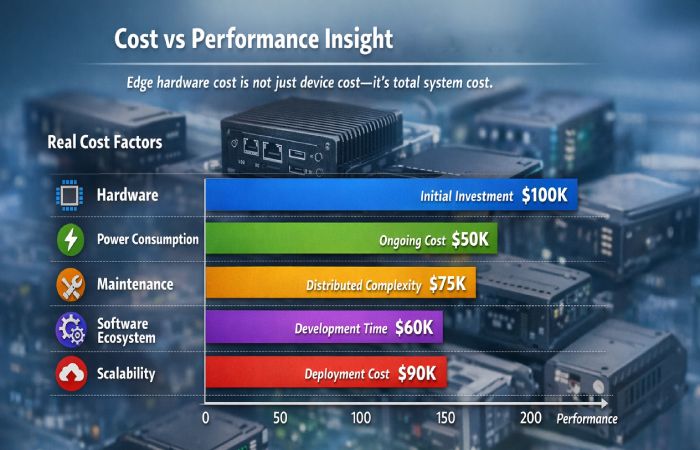
Pro Buying Tips
| Tip | Why It Matters |
| Check RAM & GPU | AI workloads require high compute |
| Verify compatibility | OS + SDK support is critical. |
| Consider power consumption | Important for remote deployment |
| Look for ecosystem support. | NVIDIA and Coral have strong ecosystems |
| Avoid the cheapest options unthinkingly. | Stability > price in edge deployments |
Edge Devices vs Cloud vs IoT
Edge devices sit between IoT and cloud—they are the “decision layer.”
| Category | Edge Devices | Cloud Systems | IoT Devices |
| Role | Local processing | Central processing | Data generation |
| Location | Near the data source | Remote data centers | Field/environment |
| Latency | Very low | Moderate/high | Depends |
| Intelligence | Medium to high | Very high | Low to medium |
| Dependency | Partial internet | Full internet | Often connected |
| Example | Edge gateway, smart camera | AWS EC2 | Sensors, wearables |
Why Edge Devices Matter
Most blogs oversimplify edge computing by framing it as “low latency.” That’s incomplete.
The real value lies in data economics and system scalability.
According to NVIDIA, processing data at the edge reduces data transfer and enables real-time decision-making and autonomous operations.
| Benefit | Explanation | Real Impact |
| Low Latency | Processing happens near the data | Enables real-time systems |
| Bandwidth Reduction | Only relevant data is sent to the cloud | Lower operational cost |
| Privacy | Sensitive data stays local | Compliance (GDPR, HIPAA) |
| Reliability | Works without constant internet | Ideal for remote areas |
| Scalability | Distributes computing load | Avoids cloud overload |
Benefits of Using Edge Devices
| Benefit | Explanation | Business Impact | Example Use Case |
| Low Latency | Data is processed near the source instead of traveling to the cloud | Faster decision-making and real-time responses | Autonomous vehicles, industrial robots |
| Reduced Bandwidth Usage | Only filtered or relevant data is sent to the cloud | Lower data transfer costs and network load | Smart surveillance systems |
| Improved Data Privacy | Sensitive data stays on local devices | Better compliance with regulations (GDPR, HIPAA) | Healthcare monitoring devices |
| Offline Functionality | Devices can operate without constant internet connectivity | Increased reliability in remote or unstable environments | Oil rigs, rural IoT deployments |
| Real-Time Analytics | Immediate data processing and insights | Enables automation and faster operations | Smart manufacturing |
| Cost Optimization | Reduces cloud storage and processing costs | Better ROI in large-scale deployments | Retail analytics systems |
| Scalability | Distributed architecture reduces central system load | Easier to scale large IoT networks | Smart cities infrastructure |
| Enhanced Security | Less data exposure during transmission | Reduced risk of cyberattacks | Financial transaction systems |
| Faster Response Time | Eliminates round-trip delays to cloud | Improves user experience | AR/VR applications |
| Energy Efficiency | Local processing reduces unnecessary data movement | Lower overall energy consumption | Edge AI devices in IoT |
How Edge Device Architecture Works
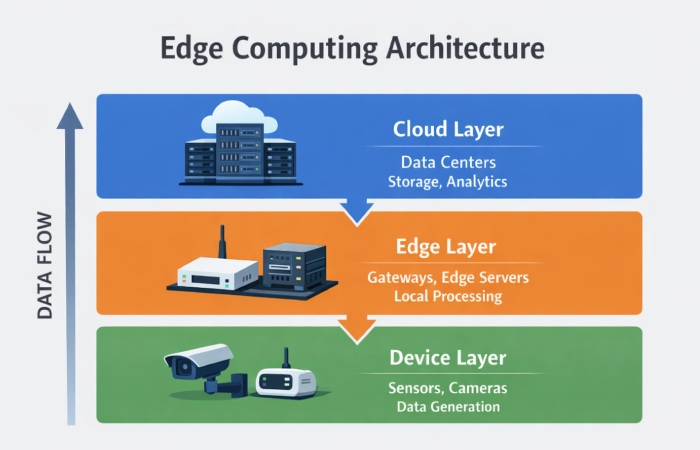
Edge computing is typically structured in a 3-layer architecture. The edge layer acts as a “smart filter” between raw data and cloud intelligence.
| Layer | Components | Function |
| Device Layer | Sensors, cameras | Data generation |
| Edge Layer | Gateways, edge servers | Local processing |
| Cloud Layer | Data centers | Storage, analytics |
Industry Applications of Edge Devices
Edge devices are not “future tech”—they are already mission-critical across industries.
-
Manufacturing (Industry 4.0)
Edge devices monitor machines in real time and detect anomalies instantly.
| Use Case | Edge Role | Outcome |
| Predictive Maintenance | Analyze sensor data locally | Prevent downtime |
| Quality Control | Computer vision on the production line | Reduce defects |
| Robotics | Real-time control loops | Faster automation |
Without edge: delays = production losses.
-
Healthcare
Healthcare requires instant decision-making + data privacy.
| Use Case | Edge Device Role | Benefit |
| Wearables | Monitor vitals locally | Immediate alerts |
| ICU Monitoring | Real-time data analysis | Faster intervention |
| Medical Imaging | Edge AI processing | Reduced cloud dependency |
-
Smart Cities
Cities generate massive real-time data streams.
| Use Case | Edge Function | Impact |
| Traffic Management | Process camera feeds locally | Reduce congestion |
| Surveillance | Real-time threat detection | Improved safety |
| Energy Systems | Local optimization | Lower energy waste |
-
Retail & E-commerce
Retail is becoming data-driven at the physical store level.
| Use Case | Edge Role | Outcome |
| Customer Analytics | Track behavior in-store | Personalization |
| Inventory Monitoring | Real-time updates | Reduced stockouts |
| Checkout Systems | Edge-based POS | Faster transactions |
-
Autonomous Vehicles
One of the most critical edge computing applications.
| Function | Why Edge Is Needed |
| Object detection | Millisecond decisions required |
| Navigation | Cannot rely on cloud latency |
| Safety systems | Must work offline |
-
Telecommunications (5G Edge)
Edge devices are embedded in telecom infrastructure.
| Use Case | Role |
| Content delivery | Reduce latency |
| AR/VR streaming | Real-time rendering |
| Network optimization | Local traffic routing |
Recommended Edge Hardware
Here’s where most blogs stay vague. Let’s get specific.
Popular Edge Computing Hardware
| Device | Best For | Key Features |
| NVIDIA Jetson Nano | AI, robotics | GPU-enabled, high-performance |
| Raspberry Pi 4 | Prototyping | Low cost, flexible |
| Google Coral Dev Board | Edge AI inference | TPU acceleration |
| Intel Neural Compute Stick 2 | AI acceleration | USB-based inference |
| BeagleBone AI-64 | Industrial use | Real-time processing |
These devices are widely used for edge AI workloads, such as vision systems, robotics, and smart automation.
Hardware Categories Explained
| Category | Description | Example |
| Single Board Computers | Compact, affordable | Raspberry Pi |
| AI Accelerators | Dedicated ML chips | Google Coral |
| Industrial PCs | Rugged, reliable | Edge gateways |
| Embedded Systems | Built into devices | Smart cameras |
Advanced Edge Platforms
Enterprise-grade solutions include:
- NVIDIA Jetson (embedded AI computing)
- AWS IoT Greengrass (device orchestration)
These platforms allow devices to:
- Run AI models locally
- Filter and aggregate data
- Communicate securely with cloud systems
Edge Devices + AI
The Edge devices are becoming intelligent—not just reactive.
Edge AI means: Running machine learning models directly on edge devices
Why It Matters
| Traditional AI | Edge AI |
| Cloud-based | Local inference |
| High latency | Real-time |
| Data transfer heavy | Minimal data transfer |
Real Examples
| Application | Edge AI Role |
| Face recognition | Process video locally |
| Voice assistants | Offline processing |
| Fraud detection | Real-time decisions |
Challenges of Edge Devices
Edge computing is powerful—but not perfect.
| Challenge | Explanation |
| Resource Constraints | Limited CPU and memory |
| Security Risks | Physical access vulnerability |
| Device Management | Hard to scale across thousands |
| Cost of Hardware | High for AI-capable devices |
Even advanced research shows edge devices must balance performance, power consumption, and memory usage, especially for AI workloads.
Edge Devices vs IoT
| Aspect | IoT Devices | Edge Devices |
| Function | Data collection | Data processing |
| Intelligence | Low | Medium–High |
| Example | Sensor | Edge gateway |
Edge devices turn IoT data into actionable intelligence.
Future of Edge Devices
Edge Will Not Replace Cloud
The future is hybrid architecture.
Every Device Is Becoming “Smart.”
Even simple devices now include:
- AI chips
- Local processing
Edge + 5G = Explosion
Ultra-low latency
Massive device connectivity
Decentralized Computing Will Rise
We’re moving from:
- Centralized cloud
- Distributed intelligence
When Should You Use Edge Devices?
| Condition | Why Edge Works |
| Real-time processing needed | Low latency |
| High data volume | Reduce bandwidth |
| Remote location | Works offline |
| Sensitive data | Better privacy |
When NOT to Use Edge
| Scenario | Reason |
| Heavy compute workloads | Cloud is stronger |
| Centralized analytics | Easier in cloud |
| Low urgency tasks | Latency not critical |
Conclusion
Edge devices are transforming computing by bringing data processing closer to where it’s created. They enable faster decisions, lower costs, and better privacy—especially in real-time applications. Rather than replacing the cloud, they work alongside it, forming a hybrid model that is shaping the future of modern technology.