
The phrase “A Network Engineer” used to describe someone who configured routers and fixed connectivity issues. Today, that definition is outdated.
Modern network engineers operate in a hybrid world of cloud, security, and automation, where infrastructure is increasingly software-defined. Businesses rely heavily on stable networks to run applications, enable remote work, and secure data—making this role more critical than ever.
To understand core networking concepts like TCP/IP and network architecture in more depth, resources from Cisco Networking Academy provide structured, industry-recognized learning paths.
Table of Contents
What Does a Network Engineer Actually Do?
A network engineer ensures systems communicate efficiently, securely, and reliably. But that’s just the surface.
| Function | What It Involves | Real-World Impact |
| Network Design | Designing LAN, WAN, cloud networks | Scalable infrastructure |
| Configuration | Routers, switches, firewalls | Stable connectivity |
| Monitoring | Performance tracking tools | Reduced downtime |
| Troubleshooting | Diagnosing failures | Business continuity |
| Security | Firewalls, VPNs, access control | Data protection |
| Automation | Scripts & tools (Python, Ansible) | Efficiency & scalability |
Time Distribution of a Network Engineer’s Work
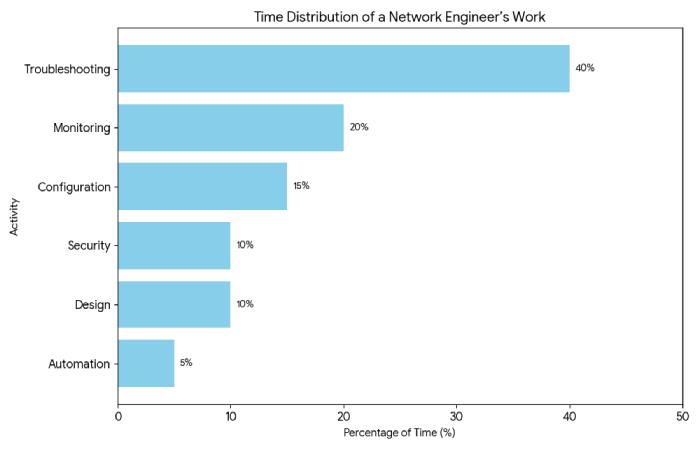
Troubleshooting dominates early careers, while design and automation grow with experience.
Types of Network Engineers
Not all network engineers follow the same trajectory. Specialization plays a major role in career growth and salary.
Career Path Comparison
| Role | Focus Area | Skills Needed | Salary Range (India) |
| Network Administrator | Maintenance | Basic networking | ₹2–6 LPA |
| Network Engineer | Core networking | Routing, switching | ₹4–9 LPA |
| Network Security Engineer | Security | Firewalls, VPNs | ₹6–12 LPA |
| Cloud Network Engineer | Cloud infra | AWS, Azure | ₹8–20 LPA |
| Network Architect | Design | Advanced systems | ₹20–35+ LPA |
Career Growth Path
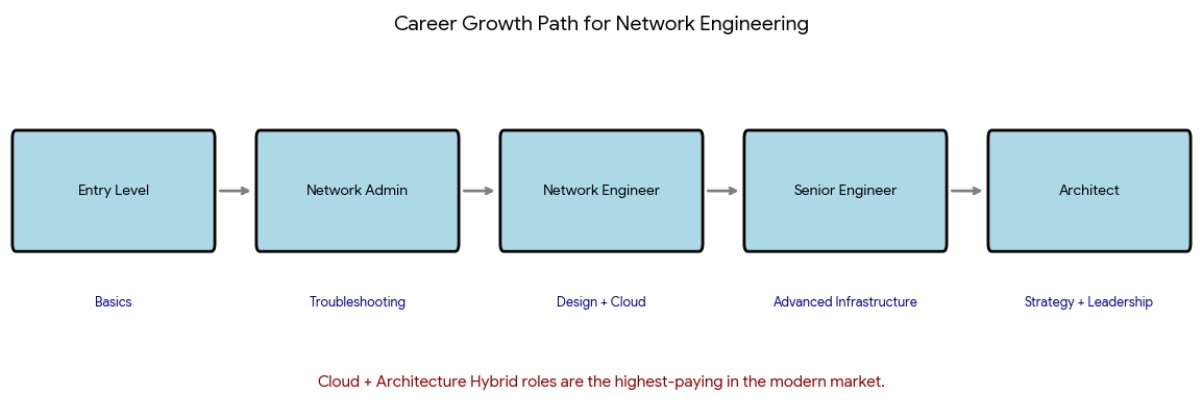
The highest-paying roles are no longer traditional—they are cloud + architecture hybrid roles.
Skills You Need
Let’s separate real skills from generic lists.
| Skill Category | Examples | Demand Level |
| Core Networking | TCP/IP, Subnetting | High |
| Routing Protocols | OSPF, BGP | High |
| Security | Firewalls, VPNs | High |
| Cloud Networking | AWS, Azure | Very High |
| Automation | Python, Ansible | Very High |
According to job market data, cloud skills appear in 78% of listings, and soft skills appear in 60% of job descriptions.
Most In-Demand Skills
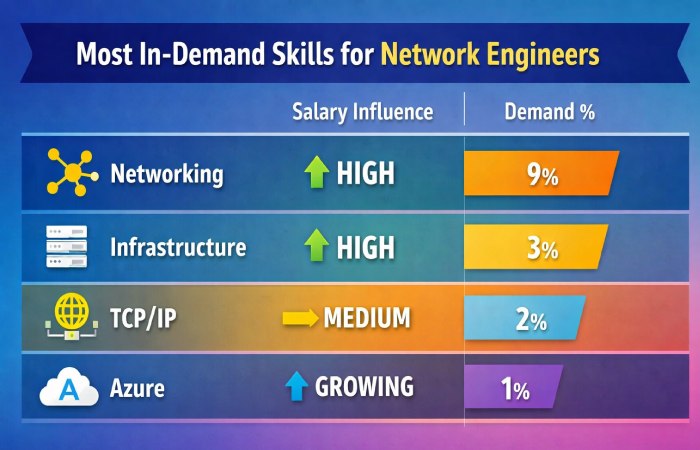
Even though “Networking” is core, cloud + automation skills multiply earning potential.
Tools Every Network Engineer Uses
| Category | Tools | Purpose |
| Monitoring | Wireshark, Nagios | Analyze traffic |
| Simulation | Cisco Packet Tracer | Practice labs |
| Automation | Python, Ansible | Reduce manual work |
| Cloud Tools | AWS VPC tools | Manage cloud networks |
Salary & Outlook
Salary is one of the most searched aspects of this career—and also one of the most misunderstood.
| Category | Segment | Salary Range | Region/Country | Key Insight |
| Global Average | Overall | $50,000 – $60,000 | Worldwide | Skewed by low-paying regions |
| Entry Level | 0–2 Years | $55K – $80K | USA | Strong starting salaries |
| €35K – €45K | Europe | Moderate entry pay | ||
| ₹3.5L – ₹5.5L | India | Lower due to market conditions | ||
| Mid-Level | 3–5 Years | $75K – $100K | USA | Major growth stage |
| €48K – €65K | Europe | Stable progression | ||
| ₹6L – ₹12L | India | Rapid growth phase | ||
| Senior Level | 5–10 Years | $130K – $165K+ | USA | Big salary jump |
| €65K – €95K | Europe | Strong earning potential | ||
| ₹15L – ₹25L+ | India | High demand roles | ||
| Top Roles | Cloud Network Engineer | $90K – $150K+ | Global | Fastest growing role |
| Network Security Engineer | $85K – $140K | Global | High demand | |
| Network Architect | $120K – $180K+ | Global | Strategic role | |
| CCIE / Expert | $145K – $220K+ | Global | Elite certification premium | |
| Top Countries | USA | ~$108K | North America | Highest pay |
| Switzerland | ~$84K | Europe | High cost of living | |
| Germany | ~$68K | Europe | Stable market | |
| Singapore | ~$72K | Asia | Top Asian market | |
| Regional Avg | North America | $80K – $110K | US/Canada | Highest salaries overall |
| Europe | $50K – $75K | EU Region | Moderate-high | |
| Asia-Pacific | $10K – $70K | India–Singapore | Huge variation | |
| Market Gap | Developed Countries | $70K – $110K | US/EU | Strong demand |
| Emerging Markets | $10K – $25K | India/Brazil | Lower cost-driven | |
| Skill Premium | Cloud Networking | +40–60% | Global | Biggest salary booster |
| Automation (Python/DevOps) | High increase | Global | Future-proof skill |
Step-by-Step Roadmap to Becoming a Network Engineer
Learning Path Table
| Step | Action | Tools/Resources |
| 1 | Learn basics | OSI, TCP/IP |
| 2 | Practice labs | Packet Tracer |
| 3 | Certification | CCNA |
| 4 | Learn cloud | AWS/Azure |
| 5 | Learn automation | Python |
| 6 | Build projects | Real labs |
Sample Learning Timeline
Month 1–3 → Networking Basics
Month 4–6 → CCNA + Labs
Month 7–9 → Cloud Networking
Month 10–12 → Automation + Projects
Real Industry Trends
Cloud computing is growing at 17.5% CAGR, directly impacting networking roles.
| Trend | Impact |
| Cloud Adoption | Increased demand |
| 5G Networks | New infrastructure roles |
| Cybersecurity | Strong demand |
| Automation | Fewer manual tasks |
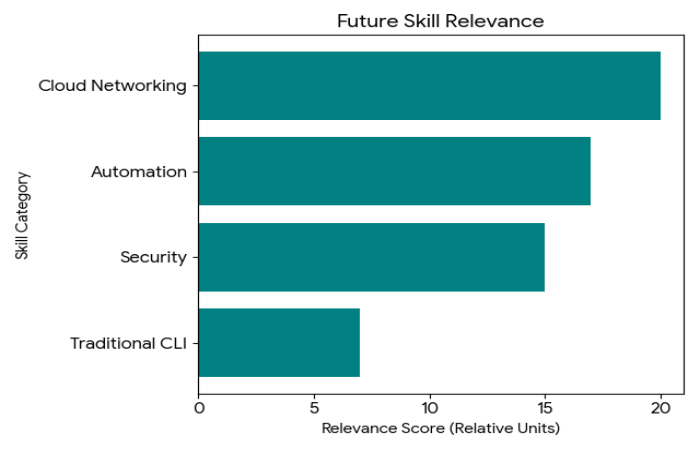
Future Skill Relevance
Common Mistakes Beginners Make
Mistake vs Impact
| Mistake | Consequence |
| Only studying theory | No job readiness |
| Ignoring cloud | Limited growth |
| Avoiding Linux | Skill gap |
| No projects | Weak resume |
Reality from Professionals
From real discussions:
“Cloud engineers make more… networking still required.”
“It wildly varies… if you’re good.”
Interpretation:
Skill depth—not just job title—determines success.
Is Network Engineering a Good Career?
| Pros | Cons |
| High demand | Continuous learning required |
| Good salary growth | High pressure (outages) |
| Global opportunities | On-call responsibilities |
| Transition to cloud/DevOps | Complex troubleshooting |
Expert POV
Most content online still treats network engineering as a static, hardware-focused job. That’s misleading.
The Reality in 2026:
- Networking is becoming software-defined
- Cloud is replacing traditional infrastructure
- Automation is replacing manual work
The Winning Formula:
| Skill Stack | Outcome |
| Networking + Cloud | High demand |
| Networking + Automation | Future-proof |
| Networking only | Risk of stagnation |
Final Takeaway
A network engineer in 2026 is far more than someone who manages routers and connectivity—they are a critical part of how modern businesses operate, combining networking fundamentals with cloud platforms, security practices, and automation tools.
The role is evolving toward software-defined and cloud-driven environments, where those who adapt by learning cloud networking and automation alongside core networking concepts will see the strongest career growth and salary potential. In simple terms, success in this field is no longer about knowing just networking—it’s about building a hybrid skill set that keeps you relevant in a rapidly changing tech landscape.